The best amplified telephones for hearing loss
Quick answer
The best amplified phone overall is the Panasonic KX-TGM420W amplified cordless with one extra handset at $219.98, which pairs a 40 decibel receiver boost with a Slow Talk feature that slows a caller's speech rather than only making it louder. Someone who wants the cheapest way to try an amplified phone should start with the Clarity P300 amplified corded phone at $55.65 instead.
An amplified telephone solves one problem: the phone call, specifically, rather than hearing in general. Receiver amplification well beyond a standard handset, large keys and a loud adjustable ringer are the features that matter, and the decibel figure is the specification every maker actually publishes, unlike the vague gain claims that circulate elsewhere in hearing gear. None of the phones below are hearing aids or a substitute for one; they work alongside hearing aids for some buyers and as a standalone fix for anyone whose difficulty is mostly confined to the phone.
The five picks are organized into Beginner, Intermediate and Expert tiers by how much phone system a household actually needs, from one simple handset to a three-room whole-house setup. If phone volume is only part of a broader hearing difficulty, hearing loss levels in decibels and what is an OTC hearing aid are worth reading alongside this page.
The picks

Clarity P300 amplified corded phone
$55.65Clarity has made amplified telephones for decades, and the P300 is its long-running corded model, with an adjustable ringer as well as receiver amplification.
Best for: The simplest, cheapest option, and a corded phone that keeps working during a power cut.
Check price on Amazon
Serene Innovations amplified big button phone
$115.95A 26 decibel corded phone with very large keys, designed around the needs of someone who is also managing memory difficulty rather than hearing alone.
Best for: A household where simplicity matters as much as volume.
Check price on Amazon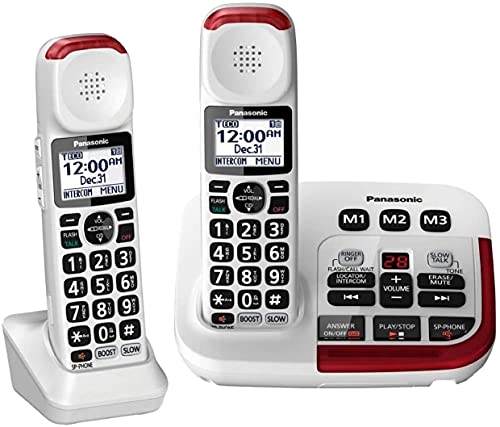
Panasonic KX-TGM420W amplified cordless with one extra handset
$219.98Panasonic publishes a 40 decibel receiver volume boost and a Slow Talk feature that slows a caller's speech in real time, which addresses a different problem than loudness: a fast talker is hard to follow even when perfectly audible.
Best for: A house that needs a handset in more than one room, where following speech is the difficulty, not only hearing it.
Check price on Amazon
Swissvoice big button phone with answering machine
$76.99Large keys and a loud handset with an answering machine included, which is otherwise usually a separate purchase.
Best for: Replacing an old phone and an old answering machine at the same time.
Check price on Amazon
Panasonic KX-TGM420W amplified cordless with two extra handsets
$299.97The same 40 decibel boost and Slow Talk system as the intermediate pick, with a third handset added for a larger house.
Best for: Covering three rooms without the phone having to be carried from room to room.
Check price on AmazonHow the tiers compare
Only two of the five picks publish an exact decibel figure for the receiver boost; the others state "adjustable" or do not publish a number at all.
| Model | Tier | Price | Amplification |
|---|---|---|---|
| Clarity P300 | Beginner | $55.65 | Adjustable, no stated dB figure |
| Serene Innovations Big Button Phone | Beginner | $115.95 | 26 dB |
| Panasonic KX-TGM420W, 2 handsets | Intermediate | $219.98 | 40 dB, plus Slow Talk |
| Swissvoice Big Button Phone | Intermediate | $76.99 | Not published |
| Panasonic KX-TGM420W, 3 handsets | Expert | $299.97 | 40 dB, plus Slow Talk |
Buying tips
The decibel figure is the one spec on this page that is directly comparable between makers, so treat "adjustable" or an unpublished figure as a reason to check reviews more carefully rather than assume it matches a stated number elsewhere. Slow Talk and similar speech-slowing features solve a genuinely different problem than raw volume: a caller who talks quickly can be perfectly audible and still hard to follow, which is a common complaint that a louder ringer does nothing for.
The Expert tier three-handset system is not the right purchase for a single-room apartment or someone living alone; the one-handset Intermediate version covers that need for over eighty dollars less. An existing amplified phone system can also be extended one room at a time: VTech SN5107 amplified additional handset adds a room to a compatible VTech base station, but it is an additional handset only and does nothing on its own without that base station already in place.
Corded phones keep working when the power goes out, which is worth weighing against the convenience of a cordless handset, especially for anyone who lives alone.
How we chose
We compared manufacturer published specifications, the FDA device classification each product is sold under, and the recurring themes in verified owner reviews. We do not test hearing devices in person and we never claim to, because a hearing device is fitted to one person's ears and a reviewer's experience of one would tell you nothing about yours.
What we exclude, and why it is most of the category. Amazon results for "hearing aids" are dominated by unbranded amplifiers listed as over the counter hearing aids. A personal sound amplification product is not an FDA regulated hearing aid, and the FDA states plainly that it is not intended to compensate for hearing loss. Products with no identifiable manufacturer, products whose stated brand and title disagree, and products quoting a gain figure as though it were a published specification are left out. Honest personal amplifiers are carried in their own separate category and are labelled as such on every card.
We make no claim about how much any device will improve anyone's hearing. That is an outcome about a person, not a property of a product, and nobody selling one can tell you it either.
Common questions
- What decibel boost should I actually look for in an amplified phone?
- There is no single correct number, since it depends on the individual and is not a substitute for a hearing evaluation. What matters is comparing published figures like for like: the picks above range from 26 dB to 40 dB where a maker states a figure, and a phone that states "adjustable" instead of a number should be judged on its adjustable range rather than assumed to match a stated figure elsewhere.
- Will an amplified phone work if my hearing loss is more than mild?
- An amplified phone is an accessory rather than a hearing aid and is not classified by hearing loss severity the way OTC or prescription devices are. Many people with more significant hearing loss use an amplified phone alongside hearing aids rather than instead of them, since the phone's job is isolating call audio from the room.
- Does an amplified phone still work during a power outage?
- A corded model like the Clarity P300 or the Serene Innovations big button phone keeps working as long as the phone line itself is active, since corded phones typically draw power from the line. A cordless system with a charging base, like the Panasonic KX-TGM420W, stops working once its battery runs down without power to recharge it.
- Can I add another handset to an amplified phone system I already own?
- Only if the additional handset is compatible with your specific base station. The VTech SN5107 above, for example, is an additional handset for the VTech SN series only and will not connect to a Panasonic or any other brand's base station. Check the exact model family printed on the base before buying an add-on handset, since a mismatched handset simply will not pair no matter how similar it looks.
- Is an amplified phone a substitute for a hearing aid?
- No. An amplified phone solves one situation, the phone call, and does nothing for conversation in a restaurant, a television at normal volume, or a doorbell. It is frequently a good first purchase for someone whose difficulty is confined to the phone, and a useful companion device for someone who already wears hearing aids.
Get the complete hearing gear list
Every item in the starter, everyday and full setups, with running totals, in one printable list. It opens with a hearing evaluation, because that is genuinely the first step. No charge.
One list, no sequence of daily emails, and you can leave at any time.
Last updated 2026-09-17.