What does this decibel level sound like
Quick answer
Enter a level in decibels A-weighted and this returns the everyday sounds nearest to it and whether it sits above 85 dBA, where the NIOSH recommended exposure limit begins. Above that threshold it also returns the permissible exposure time.
Decibel comparison
A-weighted decibels, the figure a sound level meter reports and the one every hearing conservation limit is written in.
Enter values above to see the answer.
Equipment this answer points to

ProCase ear defenders, 33 dB SNR
$11.99The cheapest protection here, and adequate protection bought is better than excellent protection not bought.
Check before buying: The 33 figure is an SNR, the European rating, not an NRR. SNR figures run a few decibels higher than NRR figures for the same product, so this is not directly comparable with the 34 NRR muff above.
Best for: A spare pair for the shed, or protection for a visitor.
Check price on Amazon
RISEPRO digital sound level meter
$16.90The cheapest meter here, and adequate for the question most people are asking, which is whether a room is above or below 85 dBA.
Best for: A one-off check rather than ongoing monitoring.
Check price on Amazon
Hearprotek concert earplugs, two pairs
$16.99Two pairs at under seventeen dollars, which is the cheapest honest entry into filtered protection.
Best for: A first pair, and a spare, before spending forty dollars on something that may not fit.
Check price on Amazon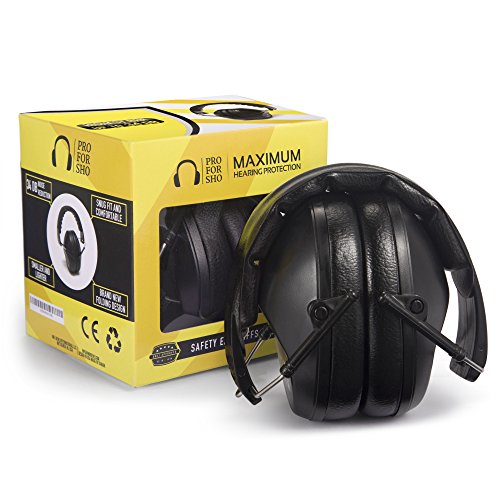
Pro For Sho ear defenders, 34 dB NRR
$19.99A 34 decibel Noise Reduction Rating, at the top of what passive muffs achieve, in a slim shell that fits under a helmet.
Check before buying: The NRR figure comes from a laboratory fit. Real world reduction is reliably lower, and a muff worn over glasses arms or long hair loses several decibels of it.
Best for: Chainsaws, mowing and workshop work, where the NIOSH tables say protection is genuinely needed.
Check price on AmazonCommon questions
- What is the difference between dBA and dB?
- A-weighting is a filter that approximates how sensitive human hearing is at different frequencies. Human hearing is far less sensitive to very low frequencies, so an unweighted reading overstates how loud a bass heavy sound seems. Every figure in hearing conservation is A-weighted, which is why the exposure limits are written 85 dBA rather than 85 dB.
- Is 85 decibels loud?
- It is about the level of city traffic heard from the pavement, and it is the level at which the NIOSH recommended exposure limit begins. Eight hours at 85 dBA is the reference exposure. It does not sound alarming, which is precisely the difficulty: noise damage accumulates over years at levels that feel entirely ordinary.
- Why is 90 decibels not slightly louder than 85?
- Because decibels are logarithmic. An increase of 10 decibels is roughly a tenfold increase in sound intensity and is usually perceived as about twice as loud, so 5 decibels is a much larger jump than the numbers suggest. It is also why the NIOSH permissible time halves for every 3 decibel rise rather than falling gradually.
- Can I trust a phone app to measure this?
- For deciding whether a space is obviously loud, yes. For a figure you would act on, no. Phone microphones are not calibrated, they vary between handsets, and most are designed to compress rather than measure. A handheld sound level meter costs very little and reports a figure with a stated range and accuracy.
- Does distance change the level?
- Considerably. For a point source in the open, doubling your distance reduces the level by roughly 6 decibels. That is why every figure on this site is quoted at a usual listening distance rather than as a property of the object, and why a measurement taken where you actually stand is worth far more than a table.
Get the complete hearing gear list
Every item in the starter, everyday and full setups, with running totals, in one printable list. It opens with a hearing evaluation, because that is genuinely the first step. No charge.
One list, no sequence of daily emails, and you can leave at any time.